
Open the cock and the tool runs. Close it and the tool stops. It sounds elementary, but anyone who has run a workshop or a production line knows that the quality of the coupling or the cock is the difference between a quiet air network and one that leaks, whistles and leaves you working at half pressure.
Sistem Pneumatica has produced pneumatic cocks and automatic couplings for compressed air since 1978: compact, robust lines, compatible with the main international coupling standards.
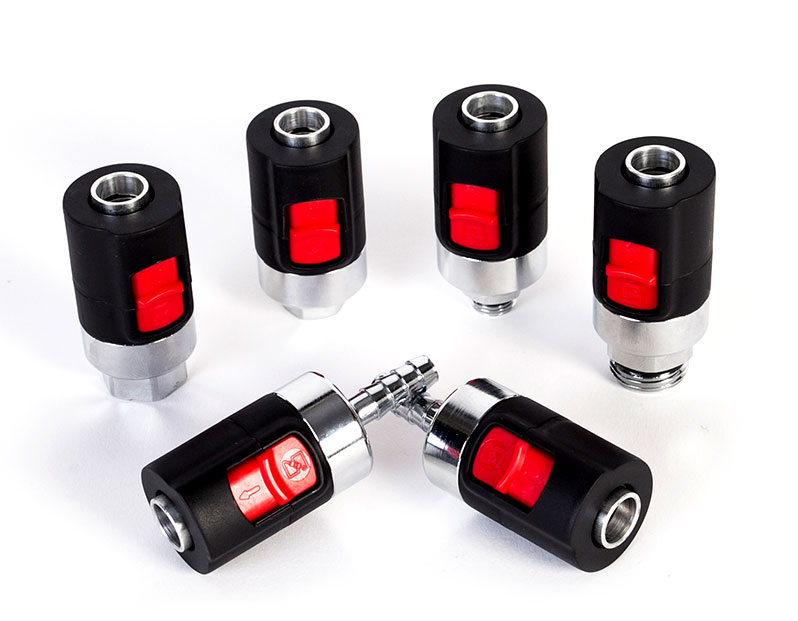
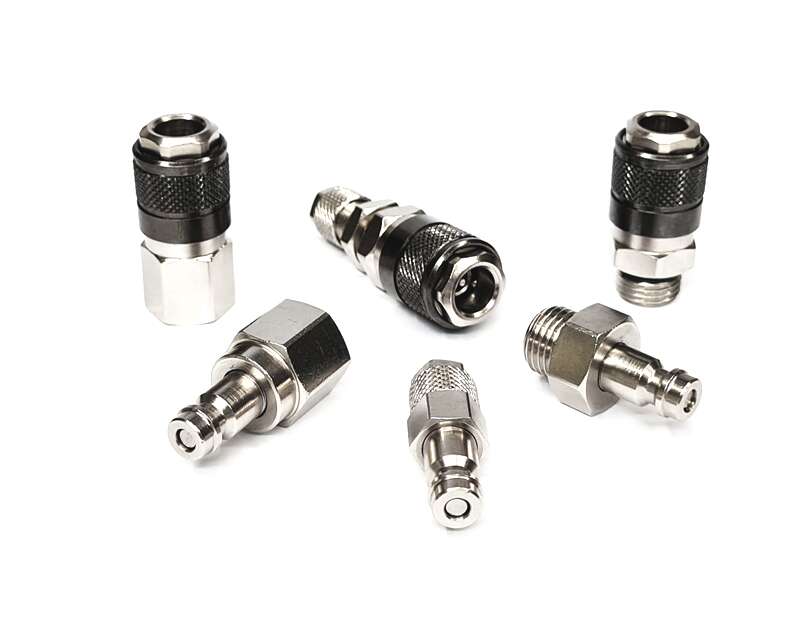
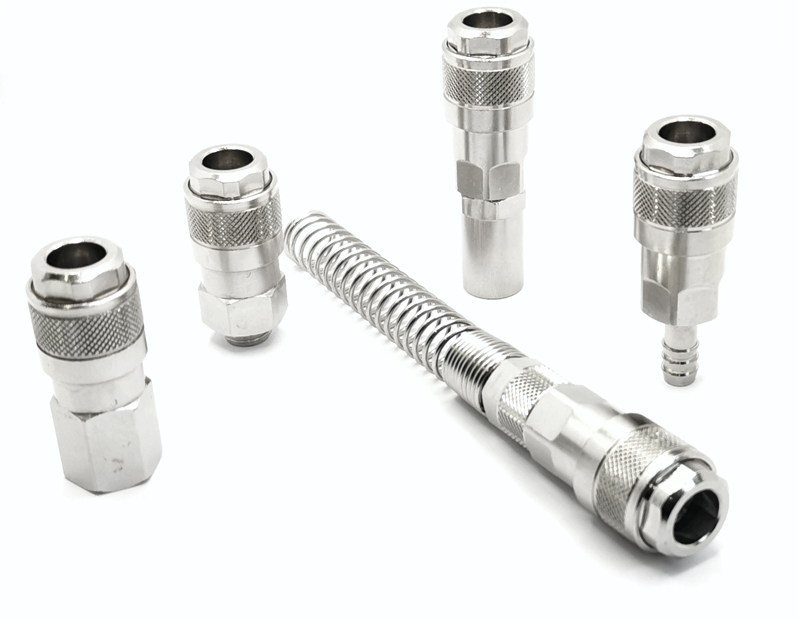


What pneumatic cocks are and what they do
Pneumatic cocks — also called automatic couplings or quick couplings — are devices that connect or isolate two sections of a compressed air installation, either manually or automatically.
They serve three scenarios:
- Air take-off points in the workshop and on assembly benches (fast tool changes)
- Isolating network branches during maintenance (shut down one area without stopping the installation)
- Connecting mobile lines to distribution panels
The four Sistem cock families
Universal and mignon automatic couplings: the new-generation quick couplings. The universal range accepts the main plugs on the market — European/German, ISO-B/American, Swiss/Swedish/ARO and Italian. Anyone arriving in the workshop with a tool on a standard plug can connect it. The Mignon Dual Shut-off version (recognisable by its black collar) has one very useful feature: it blocks the medium on both sides of the circuit when the plug is not inserted, preventing air loss at the socket side and the tool side alike.
Slide cocks: the coupling opens or closes by sliding the collar. A simple, robust, long-lived mechanical solution. Typical of workbenches where a fast, dependable manual command is needed.
Ball valves: quarter-turn lever. Open or closed, no intermediate positions. The classic shut-off valve, available in several formats — RSM mini M/F, RSSM standard M/F, RSF mini F/F — to cover every flow and footprint requirement.
K series: a modular line integrated with the rest of the K fittings range, ideal where custom distribution panels are being built.
Plug and socket compatibility: a detail that often slips through
The critical point on the shop floor is compatibility between the coupling (the socket) and the plug on the tool. There are four main world standards: European/German (DIN 7252), ISO-B (American), Swiss/ARO and Italian. Historically each country developed its own profile, and today you end up with Italian, American, German and Asian tools all on the same network.
The Sistem universal automatic coupling line exists precisely for this: one socket accepts every standard plug. For anyone struggling to keep order in the workshop, that is a significant simplification.
Frequently asked questions
What is the difference between a universal quick coupling and a standard one?
A standard quick coupling accepts only plugs of its own profile (European only, for example). A universal one is designed to take plugs of different profiles — European, ISO-B, Swiss, Italian — on a single socket. It is the right answer when tools from various origins circulate around the workshop.
What does “dual shut-off” mean on a mignon coupling?
It means the coupling blocks air flow on both sides of the circuit when the plug is not inserted. No leak when you pull the tool off, no whistle from the socket on the installation side, no wasted air. You can identify it visually by the black collar.
When should I choose a ball valve over a slide cock?
The ball valve is faster (a quarter turn to open or close fully) and its maximum flow matches a tube of the same diameter — so there is no pressure drop in the open position. The slide cock gives a more gradual linear command, easier to modulate by hand and typically slimmer in profile. For fast isolation the ball valve wins; on benches where space is tight, the slide cock does.
Can Sistem ball valves be installed on plastic tubing?
Yes, provided the threaded connection is compatible (BSP parallel or taper) and the tubing is properly connected with a dedicated fitting. On polyurethane or polyamide tubing you always interpose a push-in or compression fitting — the valve should never be threaded directly onto the plastic tube.
What is the flow rate of a 1/2″ ball valve?
It depends on network pressure and the valve’s actual bore. As a rule of thumb, a full-bore 1/2″ ball valve at 7 bar delivers roughly 4,000–5,000 Nl/min, enough to feed most workshop air tools simultaneously. For precise sizing, always work from the flow curve on the data sheet.
How do I tell whether a plug is European, ISO-B, Swiss or Italian?
By eye it is almost impossible — the differences run to fractions of a millimetre. The safe route is to compare the plug against the profile table (there is one in our catalogue) or read the manufacturer’s marking. Where doubt remains, Sistem universal automatic couplings solve the problem by accepting all the main profiles.
Looking for a coupling that takes any tool you throw at it? Explore the Sistem universal automatic coupling line, or write to our engineering department to identify the right profile.

 Sistem Pneumatica