
A fitting that leaks is a line that stops. For anyone designing or maintaining a pneumatic circuit, choosing the fitting is never a detail: working pressure, the medium being carried, tube type, how often it gets disconnected and the installation environment all change which product is the right one.
Sistem Pneumatica has designed and manufactured pneumatic fittings since 1978, and today offers a complete range covering every requirement in industrial compressed air, from low pressure right up to 250 bar.





What pneumatic fittings are and what they do
Pneumatic fittings are the components that connect tubing to threaded parts inside a compressed air circuit. They sit between the valve and the actuator, between the filter and the cylinder, between the manifold and the end user. It sounds trivial — right up until one lets go and you realise half the line was being held together by a seal worth a few cents.
Good fittings have to deliver three things: a perfect pneumatic seal, quick assembly, and service life that holds up under vibration and repeated cycling.
Types of pneumatic fitting available
The Sistem range is built along two axes: how the tube is gripped, and what the fitting is made of. Let’s take them one at a time.
By tube connection
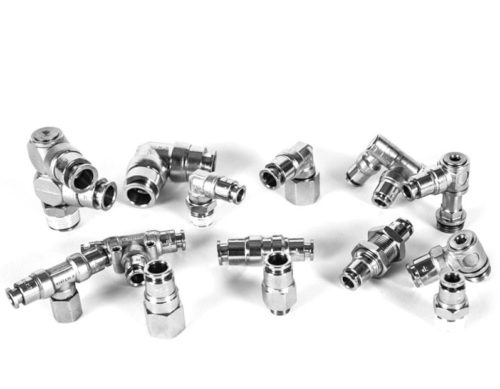
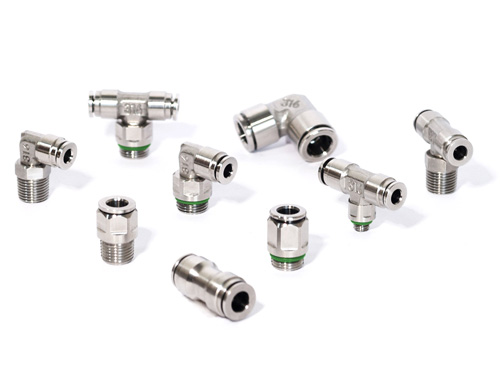
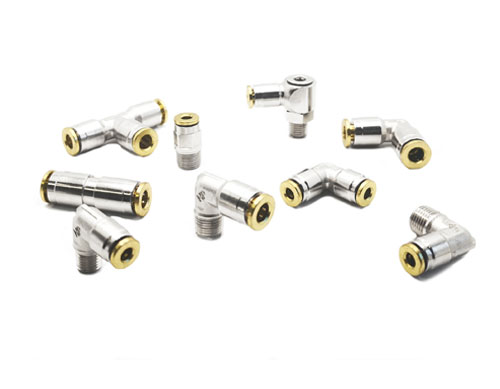
- Push-in fittings: the tube pushes straight in, no tools needed. Release takes seconds — just press the collet ring. Available in the Metallo, Easy, K, Resina, stainless steel and HP series.
- Super-fast push-in / Air-Clip fittings: an even more immediate connection, thanks to a dedicated locking mechanism that makes the product modular and lets you build a wide range of shapes from very few part numbers. Ideal where connections are made and broken many times a day, and particularly useful in plant maintenance.
- Compression fittings: the tube is clamped by a cone nut that guarantees the seal. Higher vibration resistance — the typical solution on machine tools.
- Olive fittings: a tapered profile that mechanically locks the tube. Leak-tight even under fluctuating pressure. Used where the circuit runs under variable load, and very often paired with metal tubing.
- HP high-pressure push-in fittings: a dedicated line for lubrication and greasing systems, rated up to 250 bar.
By material
- Nickel-plated brass: the industry standard. High mechanical strength, balanced cost, excellent compatibility with compressed air whether lubricated or not.
- AISI 316L stainless steel: the choice for aggressive environments — food, pharmaceutical, chemical, marine. Carries corrosive media without any loss of service life.
- Technopolymer: low weight, good chemical resistance, contained cost. The answer where weight counts (mobile automation benches) or where brass is ruled out on compatibility grounds.
How to choose the right fitting
Four variables decide everything: maximum circuit pressure, tube diameter (inside and out), the thread on the fixed side (BSP parallel, BSP taper, NPT, metric) and the operating environment. Get even one of them wrong and you either lose the seal quickly or wear the fitting out early. When the doubt is over material, a rule of thumb: if the circuit touches water or chemicals, or sits in a saline or sterile atmosphere, stainless steel is normally the answer. In every other case, nickel-plated brass is the right call in 90% of industrial applications.
On complex designs our engineering department supports you through the selection — which happens often, especially on custom lines where the thread-to-tube combination isn’t a standard one.
Sistem Pneumatica fittings catalogue
- Metallo series – push-in in nickel-plated brass, the industry benchmark
- Easy series – compact push-in, reduced footprint
- K series – push-in with an excellent quality-to-price ratio
- Air-Clip series – modular
- Inox 316L series – for aggressive environments and corrosive media
- Resina series – technopolymer, with the same tube grip as the Metallo series
- Calzamento series – mechanical seal with cone nut
- Ogiva series – for use with metal tubing
- HP series – high pressure up to 250 bar
Every series comes with its own technical data sheet and a downloadable STEP file for CAD design.
Frequently asked questions
What is the difference between push-in and compression fittings?
Push-in fittings connect and release by hand in seconds, which makes them the right choice wherever work is done frequently. Compression fittings give a mechanical seal that stands up better to vibration and intense pressure cycling, because the tube is locked by a collet. On machine tools under continuous stress, compression lasts longer; on automation benches with frequent disconnections, push-in is the practical answer.
When should I use 316L stainless steel fittings instead of nickel-plated brass?
316L becomes mandatory in three cases: contact with corrosive liquids (acids, alkalis, chemicals), food and pharmaceutical applications (where sterilisation and traceability are required), and saline or high-humidity environments. In every other scenario, nickel-plated brass covers practically all industrial compressed air applications at a considerably lower cost.
What maximum pressure do Sistem pneumatic fittings withstand?
The standard series in nickel-plated brass and technopolymer work up to 18 bar nominal, with actual figures depending on diameter and tube type. For high-pressure applications there is the HP line, dedicated to lubrication and greasing systems, which reaches 250 bar and uses threads specific to that sector.
Can I use push-in fittings with polyurethane tubing?
Yes, and in many cases it is the most common pairing. The condition is that the tube is calibrated (a precise outside diameter) and rigid enough not to collapse inside the collet, so it cannot pull out of the fitting under heavy tension. The TPU tubing we supply as an accessory, like our TR polyamide tubing, is already dimensioned for our push-in series.
Are STEP files available for CAD design?
Yes. Every part number has its own technical data sheet and a matching STEP file to download from the site, so that mechanical designers and engineering departments can drop them straight into their 3D models rather than redrawing them.
Does Sistem Pneumatica make custom fittings?
For production volumes, yes — we have handled a great many specials on non-standard threads, special dimensions and dedicated materials. The best route is to contact our engineering department with the drawing or the circuit diagram.
Download the full fittings catalogue or request a quote: the Sistem engineering department will also help you choose the right fitting for your line.

 Sistem Pneumatica